

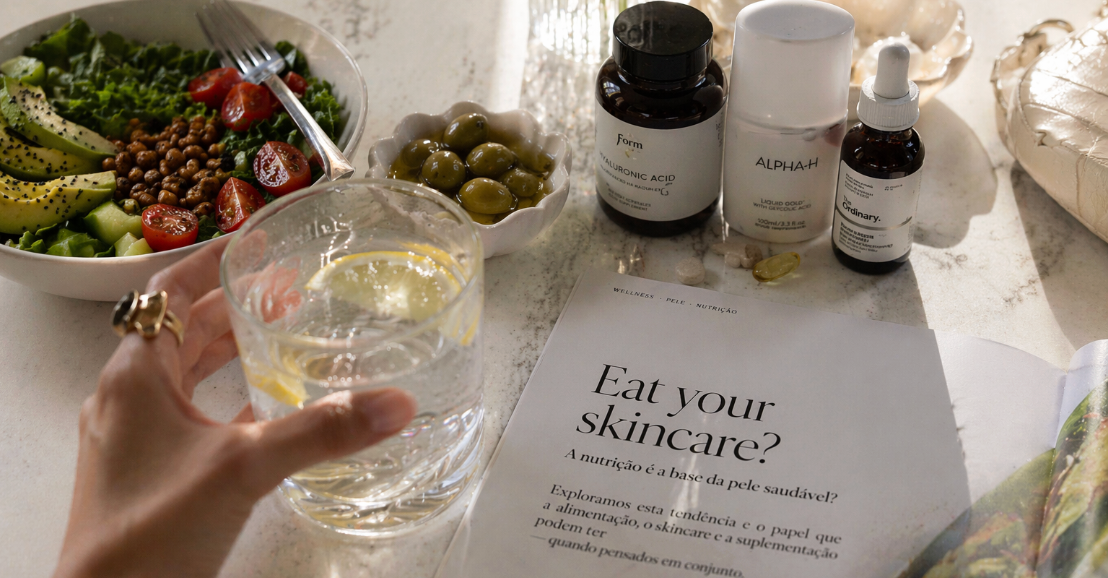
In recent months, the expression "eat your skincare" has been popping up more and more on social media and in the beauty world. At first glance, it might seem a slightly provocative idea: swapping creams for food? Setting serums aside and caring for your skin only through what's on your plate? In fact, that's not quite it.
This trend doesn't claim that diet replaces topical skincare. What it proposes is a different way of looking at the skin: before thinking only about products, formulas and complex routines, it makes sense to check whether we're giving the body the nutrients it needs to work well.
And the skin, like any other organ, depends on that too.
The skin is a living, active organ that is deeply influenced by nutritional status. Vitamin C, for example, plays a part in collagen production. Vitamin A is linked to cell renewal. Vitamin E and other antioxidants help protect cells against oxidative stress. Zinc plays an important role in wound healing and the inflammatory response. Essential fatty acids, meanwhile, help keep the skin barrier more balanced and resilient.
That's why a diet rich in fruit, vegetables, healthy fats and quality protein isn't only reflected in your overall health. It can also affect how your skin looks: brighter, more balanced and better able to regenerate.
When nutrient intake is insufficient, the skin can show signs. It may become duller and more reactive, more prone to blemishes, loss of elasticity or slower healing.
This is where the concept of "eat your skincare" starts to make sense. Not as a substitute for skincare, but as its foundation.
However, there's a part of this trend that needs to be viewed with some caution. The fact that a nutrient is important for the skin doesn't mean that, when you ingest it, it will automatically reach the skin in a sufficient amount to produce a visible effect.
When we ingest vitamins, minerals or other bioactive compounds, they enter the bloodstream and are distributed around the body according to its priorities. And, physiologically speaking, the skin isn't the top priority. Vital organs such as the brain, liver, heart or the immune system take precedence.
This means there's no direct guarantee that what we eat will reach the skin in the ideal amount, or in as targeted a way as social media often suggests. And this is a key point.
The action of an ingested nutrient isn't the same as that of a cosmetic applied directly to the skin. When we apply an active ingredient such as vitamin C, retinoids or certain acids, we're acting locally, with a specific concentration and a more targeted goal. We may be working on dark spots, texture, radiance, fine lines or hyperpigmentation.
When we ingest that same nutrient, however, it goes through a completely different process. It's absorbed, distributed and used by the body according to its overall needs. The skin can benefit, yes, but not necessarily in an immediate, visible or localised way.
That's why diet is fundamental to skin health, but it doesn't fully replace topical application, especially when it comes to more specific goals.
The problem with the "eat your skincare" trend isn't the idea of caring for your skin from the inside out. That idea makes sense. The problem is when it's simplified to the point where it seems all you need to do is eat certain foods to fix everything. Skin doesn't work like that.
Skin is influenced by many factors: diet, sleep, stress, hydration, genetics, hormones, sun exposure, pollution, skincare routine and lifestyle. There's no single step that fixes everything. What there is, is a combination of habits that, together, create better conditions for healthy skin.
And this is exactly where a third, often forgotten, dimension comes into the conversation: supplementation.
If diet is the foundation and topical skincare allows for more localised action, supplementation can work as a strategic complement. Not as a miracle solution, but as a way to boost certain nutrients more consistently.
This can be especially relevant at times when your diet isn't perfect, when the body's needs are higher, or when we want to ensure a more regular intake of certain compounds associated with skin health.
In practice, supplementation can help create more favourable ground. By providing nutrients more steadily, it helps the body have greater availability of these compounds and, potentially, allows the skin to benefit from them too.
Of course, this doesn't mean a supplement replaces a good diet, a suitable skincare routine or healthy habits. But it can be a useful tool within a more complete approach.
And perhaps that's the big takeaway.
Skin isn't cared for with creams alone. But it isn't cared for with food alone either. And even less so with simplistic promises.
The real progress lies in understanding that the skin is part of a system. What we eat, what we apply, how we rest and how consistently we look after ourselves all have an impact.
So perhaps the idea isn't exactly "eat your skincare".
Perhaps it's more like this: caring for your skin in an integrated way, respecting what it needs on the inside and the outside. Because healthy skin doesn't start only on your plate.
Nor does it start only in the mirror.
It starts with the balance between the two.


Share:
Lactobacilli: much more than “good” bacteria
Hyaluronic acid everywhere: how far does it make sense?
1 comment
Artigo muito interessante. Faz-me concluir que o segredo de uma pele saudável está numa aproximação holística ao seu cuidado.